Friday, January 15, 2021

100. New Sustainability Reports - Specialty and Total Market

100th post - woo hoo!                                                             15. January 2021

As a fitting 100th post on this blog, we are excited to share about the 2020 Specialty Coffee Transaction Guide , which was released two days ago, 13 January, 2021. You can click here to download the report. Artisan Coffee Imports is proud to be a data contributor this year. 

Download the Transaction Guide: www.transactionguide.coffee.  

Another useful coffee industry report, covering both specialty and commodity, is being released today: the 2020 Coffee Barometer. Download this report here: https://coffeebarometer.org/
"The coffee supply chain is closely tied to the top ten multinational roasters that represent over 35 percent of global trade in green coffee and engages millions of smallholders and workers." ~ 2020 Coffee Barometer
The two reports are synergistic, because the Coffee Barometer strongly urges more pre-competitive collaboration between importers and roasters on behalf of farmers. The "Transaction Guide" is a good example of what that kind of collaboration looks like. Indeed, on page 38, the Barometer discusses the value of Transaction Guide and its transparent price sharing as an alternative to pricing based on the C market. 

For the most part, the Specialty Coffee Transaction Guide, as it's name implies, focuses on the low-volume, but high dollars-per-pound part of the coffee world -- the high-quality specialty coffee market. Meanwhile the Barometer will teach you more about the largest roasters and importer multinationals and the high-volume, low-quality, low price-per-pound commercial grade coffee trade.

It was interesting to join a promotional webinar for the Coffee Barometer today. It was hosted by a media group in Amsterdam named CIRCL. Below are some highlights and a summary of a few of the comments from their high-powered panel of guests.

Moderator: Bahram Sadeghi, journalist
Speakers:

Sjoerd Panhuysen, Director of Research at Ethos Agriculture and editor of the Coffee Barometer. 
Kaitlin Cordes, Researcher at Columbia Center on Sustainability in New York City. She discussed the recommendations of the Jeffery Sachs report to the World Producers' Forum.
Vanusia Nogueira, Director, the Brazil Specialty Coffee Association (BSCA).
Mario Cerutti, Chief Sustainability Officer, Lavazza
Juan Antonio Rivas, Senior Vice President, Olam International.

I found Cordes' summary of the three recommendations of the Jeffrey Sachs report useful. They are:
1. Support each producing country to create a National Coffee Sustainability Plans, 
2. Create an international Coffee Fund of about 10 billion USD to support producer prices when they fall below a certain level.
3. Increase Domestic Consumption of coffee.

Key comments:
Less than $.005 additional price paid by consumers, for every cup of coffee sold, would make the 10 billion coffee fund possible. The criticism of this is that it is charity instead of fundamental structural change. The counter to that criticism is to think of it as the "user" side of the industry as shouldering some of the risk that currently is borne by farmers alone -- especially price and climate change risk.
A minimum farm size is needed in most countries. Diversification of income is a only a hedge and productivity improvement is only one step among many. 
According to Mario Cerutti, the "coffee crisis" is more than a crisis. It's not going away after a short time. He also commented that paying 10% of coffee exports per year into a coffee fund is not realistic. He says it will put roasters like Lavazza out of business.

Wednesday, January 13, 2021

99. Babies and Research on Better Informed Husbands

 Jan. 13, 2021         Excerpt from a World Bank Blog               

At Artisan Coffee Imports, we are regular readers of the World Bank Blog, "Development Impact." We especially appreciate posts by Markus Goldstein, and this week's post was no exception. He starts with the intriguing title, "Is an informed husband a better husband?"

The paper Goldstein reviews deserves attention because it shows that we must take issues like intra-household gender dynamics seriously if we want to tackle issues like fertility. In this study, a relatively simple intervention is observed as making meaningful progress in not only reducing the chance of pregnancy, but also shifting preferences, improving communication, and making folks happier in their marriage. 

I give you the setting of the paper here -- you will need to click and read the above link to learn the details of the intervention and results.

The setting is Lusaka, Zambia. National fertility rates are on the high side, with 5.3 children per woman aged 15-49. In this context, as in many others, men would prefer, on average, to have more children than women (in Ashraf and co’s sample, men would like 4.43, women 4.19). Maternal mortality is high: 1 in 59 Zambian women die giving birth. And men are less aware of the factors that contribute to maternal mortality than women. For example, 84.6 percent of women identify advanced maternal age as a risk factor, but only 74.3 percent of men do.

So, this adds up to a situation where men are less informed about a risk they want their wife to take. And she can’t effectively communicate this risk to him. 

(Quoted from Markus Goldstein, Development Impact Blog)

As Ashraf and co-authors argue, we still have some ways to go to understand these things better, but for now the results of this study help us get a handle on how asymmetric information and differing preferences at an intra-household level is impacting decisions about child-bearing.

Tuesday, January 5, 2021

98. New Year 2021: Inspiration from Nobel Prize Laureates

 Jan. 5, 2021    

Happy New Year! Yesterday the American Economic Association hosted a wonderful, international webinar allowing fans of the 2020 Nobel Prize in Economics laureates to get to know the people and their work a little better.

Click here to view the recording on youtube: https://www.youtube.com/watch?v=jvnojrkrRDU

The beauty of Zoom recordings allows you to feel as if you are in the room with Abhijit Banerjee, Esther Duflo and Michael Kremer, the Nobel Laureates, and people who have worked with them closely. All of the individuals speak candidly and  share the highlights of why their work has been so impactful in the world of development economics.

For any reader who has not been in the coffee industry very long, please note that at Artisan Coffee Imports we consider ourselves as participants in field of development economics, albeit at a very applied and microscopic level. 


Thursday, July 2, 2020

97. 'Cooperative Advantage' article in Roast Magazine

Cooperatives like TUK in Rwanda offer farmers many benefits
(Photo credit: Clay Enos and Sustainable Growers)
"Cooperative Advantage: What Do Cooperatives Mean for Farmers, Roasters and Consumers?" appears in the new July/August issue of Roast Magazine.

In this blogpost we'll share the highlights, but we hope you'll consider hopping over to Roast's website to purchase the issue - either digital or hard-copy. $7 for the single issue or $35 for 1 year subscription.

Co-authors Ruth Ann Church and Dr. David L. Ortega review the growing interest in coffee produced by cooperatives, including two papers published in peer-reviewed journals by Michigan State University research teams. The first paper offers quantitative results on farmer productivity and household welfare from a study from Rwanda and the Feed the Future Africa Great Lakes Coffee support program. The second paper shares results from a coffee shop field experiment with consumers of pour-over coffee. It captures willingness-to-pay for coffee based on the organization of the producers, namely coffee that is labeled 'grown by farmers belonging to a cooperative'.

Insights from these quantitative studies bring credibility to qualitative work that has been popping up across the specialty coffee industry over the past year. The Specialty Coffee Association's Kim Elena Ionescu interviewed Merling Preza of PRODECOOP at Re:Co 2019 in Boston. The non-profit TWIN published a 2019 report on producer organizations that gleaned insights from 31 producer organizations in nine countries. The common theme is that the farmer cooperative can be a valuable node in coffee value chain, providing benefits to farmers that altruistic consumers, especially millennials, are expecting in their specialty food choices.  

Cooperative members in Rwanda mitigate
soil erosion for their coffee plot.
Quantitative Results
After reviewing the context of today's consumer demand for transparency and a history of problems that come with cooperative leadership, key quantitative results are shared. First, the authors of the Food Security article find that farmers who are cooperative memberin Rwanda score significantly higher on an “adoption of best practices” index than coffee farmers who are not co-op members. The farmers belonging to cooperatives also receive more income from their workapproximately 18 percent higher revenue per coffee tree. These elevated metrics, the researchers conclude, begin a virtuous cycle for farmers who belong to a cooperative. They are more likely to have healthy soil and plants, which leads to higher productivity per tree, which then lowers cost of production per kilogram cherry, and in turn improves net income per tree. Indeed, productivity (kilos of cherry per tree) of cooperative members is 20 percent higher than that of non-members, and cost of production (Rwandan Franc/kilo cherry) is 24 percent lower than farmers who are not cooperative members. 
Courtney Gates at Espresso Elevado
in Plymouth, MI prepares a pour-over.
(Photo credit: Teresa Pilarz)

The article focusing on consumer willingness-to-pay (WTP) in Food Research International finds that when personality traits are used to segment consumers, a strong willingness-to-pay for coffee from farmers organized cooperatively can be identified. The results indicate:
  • An average WTP of an additional $1.31 per 12-ounce cup of pour-over coffee, in a specialty coffee shop setting, when the cup descriptor is “coffee grown by farmers belonging to a cooperative.”
  • Consumers with higher subjective knowledge (consumer’s self-evaluated knowledge of coffee) had lower premiums for cooperative-grown coffee, suggesting that these consumers may base their product valuation on sensory characteristics more than descriptive information of production structure.
  • The personality traits of “conscientiousness” and “extraversion” increase WTP and a higher level of the personality trait of “agency” or “outspokenness” decreases WTP (For more on the Big Six personality traits, see Bazzani, 2017, in Food Quality and Preference).
  • Age was the only statistically significant sociodemographic determinant of WTP, with older consumers being willing to pay slightly more on average.
Tough Questions Arise
These results bring up complex topics long debated in the specialty coffee industry. For example, how do consumers value basic knowledge of the producer organization type (e.g. cooperative) vs. a voluntary sustainability standard such as Fairtrade? What role does the flavor and taste in the cup play in developing consumer WTP and repeat purchases? If a cup of coffee supplied by a farmer cooperative earns a premium over other coffee at a cafe, for example the $1.31 extra measured in the experiment, what portion of these funds makes it back to the coffee grower? These are all good questions which are recommended for further research.
Lee Harrison with Joe Coffee in
New York City 
(Photo credit: Joe Coffee)

What Should Roasters Do With the Info?
The “personality traits” study raises the question of whether psychometric data on coffee consumers is already in use at roasting companies. One specialty roaster, Joe Coffee in New York City, updated its overall brand strategy a few years ago with market research ensuring employee values and brand values were aligned. The next step in brand development, according to Lee Harrison, Joe Coffee’s senior director of coffee and roasting, is to invest in consumer research to better align the brand with customers. “It’s important to get data about what people want so that we can refine our assumptions and connect with consumers in a relevant way,” he says.

Would research that identifies willingness to pay based on personality traits be of interest at Joe Coffee? Harrison replies affirmatively. “Not just for sales and profitability here in New York, but for relationships at origin, too. If farmers had this information, they could better market themselves, and it would make our job of marketing their coffee more efficient,” he says.

Recognizing that the results of this consumer study are limited by its setting, the findings still have important implications for many stakeholders in specialty coffee. It helps us to consider the diversity of coffee consumers beyond sociodemographic segmentation and instead make marketing and supply decisions with long-lasting intrinsic characteristics in mind. Combining these consumer insights with confirmation from the other studies on cooperatives’ positive impacts can encourage all who work with cooperatives and strive to make coffee better.
Sunset at Kopakama cooperative near Lake Kivu, Rwanda
Leaders of the Ejo Heza women's group appreciate one
of the roaster customers, Victrola Coffee, who pays a premium.
The Feed the Future Africa Great Lakes Coffee support program launched in August 2016 with
a workshop in Kigali, Rwanda. (Photo credit: Michigan State University)


Monday, June 15, 2020

96.5 Innovation: 300 Club Brings Incentivized Contracting to Rwanda

 June 2020 - 300 Club Introduction

“Price is the Best Fertilizer”

~ Fair Trade Cocoa Advocate

Since 2019, Artisan has been developing an idea formed with input from roasters adament about paying a farmgate price that can be defended with data as covering cost of production and a margin.

Objectives of the Program: 

·        Promoting and motivating farmers who invest in coffee with time and money. Coffee quality starts from the plantation in which good agricultural practices are applied.

·        Decrease incidents of potato taste defect (PTD). This will be achieved through best practices like careful pruning and application of pesticide. (See Gerard and Bigirimana, 2018).

·        Increase productivity of trees owned by cooperative members (farmers). Among other benefits, this will lower costs for the farmer per kg cherry harvested.

·        Increase average quality (cup score) of exportable green coffee from the cooperative. Among other benefits, this will increase revenues for the cooperative and its members.

·        Increase cherry density, which increases the ratio/rate of yield of exportable (screen 15+) green to cherries. Among other benefits, this decreases costs for the cooperative.

Effective Communication of Quality Standards via Three-tier Pricing

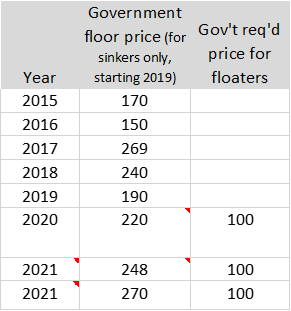
The 300 Club was designed in collaboration with Kopakama and a roaster-buyer in early 2020. It aims to give the farmer confidence that they will receive a “specialty grade” farmgate price at least 3 years in a row, IF their coffee cherry meets a quality standard set by the cooperative. In 2015, 300 Rwf/kg cherry was disclosed by NAEB to be the price farmers of high quality cherry require. Historically, NAEB sets a farmgate price that is lower than the 300 RWF/kg cherry, (see Table 1). NAEB actively enforces two prices as the only prices allowed to be paid for the first payment to the farmer – a “floater” (bad cherry) price and a “sinker” (good cherry) price. 

Table 1 – Cherry Price Tracking  (Rwf/kg cherry)

The 300 Club introduces a third price for premium cherrydefined by quality standards

·        300 Rwf – delivered in a certain time window; strict hand-sorting requirement; floaters removed

·        220-270 Rwf – (whatever is NAEB’s farmgate price) hand-sorting; floaters removed

·        100 Rwf – NAEB required price for floaters and waste

300 Club Premium to the Cooperative

The price Artisan pays to the cooperative for 300 Club coffee is paid in two parts.

·        Part 1: Artisan contracts a regular fixed contract price for microlot coffee in year 1 of the program. In 2021, $5.62/kg ($2.55/lb green) FOB was a typical microlot price for 86+ coffee.

·        Part 2: The second part is a premium paid at the beginning of year 2 and is conditional on the cooperative agreeing to pay the 300 Rwf/kg cherry price in that following year and in the first price to the farmer. In this way, the premium is paid at the time that reduces the debt the cooperative incurs to buy cherry for the season. The bonus paid to Kopakama in February 2020 was $1.00/kg green ($.45/lb) for the 300 Club coffee sold in 2019 (which was 660 kg).

 Three Year Vision for the 300 Club

This program is designed to build farmer confidence and investment over three years.  A stable price of 300 Rwf/kg for three years is expected to offer measurable impact on the objectives listed in section 1. Artisan believes roaster/ buyers will be excited by the consistency and excellent flavor of the 300 Club coffees, and request 300 Club coffee from Rwanda.


Wednesday, May 6, 2020

96. Coronavirus and Coffee: Interviews with Ten Coffee Farmers in Rwanda

May 6, 2020
Ejo Heza members harvesting in April 2017
Artisan Coffee Imports builds relationships with coffee farmers by listening to them. Harder than one might think, but it is truly powerful when it happens. Two weeks ago we arranged for a short survey-style interview with ten of the Ejo Heza farmers who produce Artisan's flagship imported coffee. Ejo Heza is a group of female farmers formed in 2011 with the support of their parent cooperative, Kopakama, in the Rutsiro district of Rwanda's Western Province. Over the years, the group has grown from 200 to 400 members. They have two community plots which they cultivate together, and each member also has coffee trees at home.

In nine of the ten interviews, the farmers said that labor was an issue, either paying for it, or finding it, or both. This is the main "finding" related to Coronavirus. To skim the actual farmer comments, see below.

It's important to note the context of these interviews. They were conducted:
Grace Izerwe - Quality Control Intern
  • By phone by Grace Izerwe, Kopakama's Quality Control Intern, who is also a trained researcher, trained coffee cupper, roaster and barista, and holds a B.S. in Rural Development and Agribusiness from the University of Rwanda.
  • During peak season, meaning the height of the harvest, when farmers are likely going to the coffee plots several times a week or daily to harvest cherry. Most likely they are using every able-bodied person in their household to help with the harvest, and hiring 'daily workers'.
Of further note:
  • There tends to be a "going rate" for daily labor in rural areas of Rwanda. Today the average daily rate is 1000 Rwf per day, (around $1.10) for someone to work from about 7am to 5pm.
  • The short survey was gathering feedback on two topics, the new "300 Club" started this year by Kopakama and the impact of Coronavirus on the farmers themselves. Here we will share about the coronavirus impacts and a future blog will discuss the 300 Club.
  • Labor is the most important component of cost of production probably in all coffee producing countries, but even more than some in Rwanda. Labor was estimated to be 75% of total cost of production in a study with data collected in 2015. (Click here for the study by Ruth Ann Church.) Of total labor, harvesting accounts for 36% of costs. 
Take-away: don't be fooled by what may seem like low-cost labor. It is a huge part of the farmer's budget and therefore doubling it, as appears to be the case for Rwanda's farmers, is going to have a likewise dramatic impact.
Ejo Heza farmer checks the quality of a coffee tree.

(Names have been changed to maintain anonymity.)
1. Epiphanie: "The stay home period is preventing us from harvesting as usual.  Since we are respecting the distancing (1m) between workers, I hire less workers than needed." (245 trees; 9 years as a member of Ejo Heza; 4 children.)

2. Floride: "The stay home period is affecting me in ways of hiring more workers because I have to pay workers the same daily salary as if they have worked the whole day." (1800 trees; 2 years as a member of Ejo Heza; 3 children.)

3. Perpetue: "The stay home period is affecting me in harvesting because before I would use 4 workers and now I am using 2 workers because you cannot find those casual laborers to help you. People are staying at home. This means those 2 available workers spend much time in harvesting. Sometimes they do not even finish the harvest of the good cherries before the delivery time set by the buyers." (660 trees; 3 years as a member of Ejo Heza; 0 children.)

4. Clementine: "It is not easy with the distancing instructions of allowing only 2 people harvesting on 1 coffee tree at the same time." (1008 trees; 6 years as a member of Ejo Heza; 3 children.)
Ejo Heza members sort cherry at the washing
station - April 2017

5. Adele: "The challenge is that I can’t afford to protect my workers with masks or hand sanitizers." (670 trees; 9 years as a member of Ejo Heza; 6 children.)

6. Seraphine: "I used to sell banana wines in bars, but now now they are closed. So it is not easy to get money to pay workers for the harvest during this lockdown." (500 trees; 4 years as a member of Ejo Heza; 5 children.)

7. Julienne: "The distancing and use of less workers is affecting me particularly as a site collector. Due to the distancing requirement, I am not allowed to get close to the farmers to work together with them on checking the cherries which they have delivered.  This takes me more time and makes some losses when I am sorting alone with workers while farmers have already gone back home. The other challenge is the sanitary and hygiene requirements. I have to always buy hand sanitizers, soaps and water to make sure everyone arriving at the site is safe from the coronavirus." (1030 trees; 4 years as a member of Ejo Heza; 4 children.)

8. Beatrice: "As many businesses closed, we are not able to invest in harvesting because we lack money to pay workers in this period of lockdown." (315 trees; 4 years as a member of Ejo Heza; 2 children.)

9. Peruth: "This lockdown is challenging me in hiring workers. Many are staying home and the available ones cost much money for harvesting." (1500 trees; 3 years as a member of Ejo Heza; 0 children.)

Those are the comments about the labor challenge. A comment during the interview from our tenth participant references a challenge unrelated to COVID:

10. Dorthee: "It is really hard in this period of rain sometimes. You can’t harvest due to heavy rains and you have to go the following day to pick the specialty coffee." (800 trees; 3 years as a member of Ejo Heza; 2 children.)

To learn more about how Rwanda's coffee sector is faring in during the pandemic, head over to our other blog, Artisan Coffee in N. America, by clicking here.


Sunday, March 15, 2020

95. New York City - International Women's Day Celebration

Mar. 15, 2020
Coffee Project NY's certified coffee lab hosed the Mar. 8 event.
Last week, March 8, was the official International Women's Day (IWD). Lots of groups celebrate empowerment of women all month long, so hopefully this post inspires you to participate in any way you can!

An exciting event took place in New York City on March 8 with a bunch of coffee people. CoffeeFest NYC was the reason many of us were in the Big Apple and the rest of the 20 people who joined were from the area.

The collaborative effort started with a few phone calls between Artisan Coffee Imports and roasters across the country, dreaming up IWD event ideas.  On the phone with Amaris Gutierrez-Ray, founder of @womenincoffeeproject and a roaster @JoeCoffee in New York, the idea sparked to have a documentary film screening at a cool New York space. Amaris reached out to Chisum Ngai ("Sum"), owner and founder of @coffeeprojectNY who readily agreed to donate her spacious, brand-new roasting plant / espresso bar / certified SCA training lab in Queens for the evening! Amaris dipped into her amazing network again to find exciting panel speakers to follow-up the film, including Lane Mitchell of @cafefemininocoffee and Gabriela Figueroa-Hueck of @ramacafenicaragua in Nicaragua (who, unfortunately, had to cancel at the last minute). Yours truly (Ruth Ann Church) agreed to be on the panel and Amaris moderated.

The evening began with networking / happy hour time with wine, cheese and crackers and tasting of brewed women-grown coffees. The 20 guests included journalists, Lisa Espenshade of Grounds for Health, Andrea Pacas from El Salvador, baristas from NY and places as far away as Connecticut and coffee company owners from Virgina and Georgia. It was tough to pull away from conversations and let the one hour movie begin. 
The film weaves together beautiful scenery and stories of several different coffee-growing families in Oaxaca, Mexico along with commentary from the importing / roasting / consuming side of the coffee value chain. 

Panel Discussion After the Film
After the film, the moderated discussion highlighted the complexity of improving women's empowerment in communities like this one in Oaxaca. One participant asked if all coffee communities have men who are as supportive of women's rights as those who are interviewed in the film. Lane Mitchell, Cafe Feminino Coffee, confirmed that supportive men, unfortunately, are still the exception in rural communities of most coffee-producing countries where she visits. Still, they exist and the more they are supported for their belief in equity by roasters who buy their coffee, the more likely these beliefs will spread quickly.
Sum (L) and Lane (R)


Another discussion point between the panel and the audience was where the "onus" lies in the coffee value chain to spark changes. Is it with the consumer, as one industry leader proposes in the film? One participant thought that is naive and that the consumer expects those with power, large roasters and importers, to generate the initiatives that drive change. In the end, there was concensus that everyone can do something in their own community at their spot in the value chain. Even just talking about the importance of gender equity in all communities is building awareness that makes a difference!


MC Amaris introduces the film.

Donations Needed!
Kimberly Easson of Partnership for Gender Equity remarks during the film that while roasters today make substantial investments in sustainability of coffee, comparatively few dollars are ever invested in coffee gender equity work. Therefore the organizers took up a collection and recently announced $125 was donated by the small crowd to the Partnership for Gender Equity.

For those who would like to make a further financial gift, the following non-profit organizations are suggested:


(Lto R) Amaris, Sum, Ruth Ann, Lane


THANK YOU to all who came to the Mar. 8 event. We hope to participate in a similar effort next year!