Thursday, May 21, 2015

28. Field Notes 5: BUF Coffee and a nearby collection site


May 21, 2015  -- BUF COFFEE  Nyarusiza

I’ve heard about BUF Coffee from numerous roasters’ blogs and from the pages of PEARL and SPREAD history. It seemed like a sign to me when I met Sam Nwitwe, the son of BUF’s owner Epiphane Mukashyaka, at SCAA Seattle in April. “Please visit,” he said. So I gave him a call.

Augustin, Grace and I took a Volcano bus from Huye to Kizi, where we switched to motos. The moto ride through the mountains on rutted dirt roads took about 30 minutes. Some of this way was so steep I was surprised the moto driver was able to keep the bike balanced.

Value Chain Insights
At the washing station there were 14 farmers assembled to talk to us. I only asked four basic questions: # of years as a farmer, # of trees and # of people from each person first. For the discussion question, “do you see a future in coffee?” there was one pessimistic and several optimistic answers.
Farmer meeting assembled at BUF Coffee

In the village we found one of the farmers again – the one who is also a site collector. I interviewed the young woman farmer who was at the site to deliver cherry. She was getting 200 Rwf and didn’t seem to know there was an option to deliver cherry for 210 Rwf by taking it up the hill to the CWS. She, like all the other farmers there, spent at least 20 – 30 minutes sorting cherry on the patio of the site collector’s building. She said there was never a better price for more quality cherry. She said all cherry had to be mature – no exceptions.

We talked to the site collector also, since he is also a farmer with many trees. Seemed like he was doing very well. Sells ordinary, too. He had a large bag of ordinary in the shop. He rents a hand depulper for making ordinary. He said a company goes around the country side renting these small machines to farmers.

At the washing station two things made me pause: the time farmers were spending sitting on the ground sorting cherry and manual removal of cherry from parchment after the coffee has come through a depulper. This scenario was especially strange because there was a person standing ankle-deep in wet parchment, in a tank, picking out the ones where the skins had failed to be removed by the depulper. The quality manager explained that they need to get them out because if they stay on during fermentation, it will taint the taste of the entire batch. I believe him. And I don't think BUF is unusual. The "result" after depulping at most washing stations is "red-spotted". But it still seems odd. Why can't the depulper more thoroughly remove all the pulp?

Another thing that made me not only pause, but made my mouth water, was the beautiful quality of cherry that farmers were delivering while we were there (see photos below).


Wednesday, May 20, 2015

27. Field Notes 4: The GIFT in Huye


May 20, 2015 -- Gift Washing Station 

Damian MANIRAKIZA is the owner of Gift coffee washing station in the Huye district of the southern province. His pride in his washing station and his commitment to growing his coffee business was clear by his enthusiastic reception of our group. His pride in his work was matched well by the farmer we were able to interview in a nearby plantation.

Process Mapping and Waste Identification:
At the washing station I took a stab at process mapping. I drew the process of getting the wet parchment from the chutes onto the shaded sorting tables, and then from the shaded tables to the sun drying tables. They’ve devised some clever parchment moving techniques, but overall this is an extremely labor intensive part of coffee production at a washing station [see image].
My sketch of transfer of parchment from chutes to drying tables.

We talked with the Damien about how labor intensive the sorting process is. He mentioned that it is much easier to identify defective beans with a UV light. I asked about installing a UV light in the “roof” of the shaded sorting tables. He said it’s too expensive. This made me reflect on how easy it is to think of such capital intensive “solutions”. What would be no or low cost? Maybe visual management signs? 

There are 5 defects they are looking for:

  1. ·         Yellow (overripe)
  2. ·         Cut
  3. ·         Insect damage (lead indicator for potato taste defect)
  4. ·         Green
  5. ·         Black

Thinking about the sorting numbers exercise we did in “Lean Tools” class, I wonder whether there’s a way to make “seeing” the blacks easier, then go to a second pass for the yellows and greens, and a third pass for cut and insect damage.

MANIRAKIZA Damien teaches our group about the process at Gift washing station.
[Later in the trip we learn that Dakunde Kawa Musasa has installed a density sorter at the front end of the washing station, essentially mechanizing the cherry floatation sorting that many washing stations do.]

First Farmer Interview
We found a farmer and his wife picking cherry about 1 km from the washing station. With Augustin’s years of experience working with and advising farmers, he was able to gently introduce our strange entourage and our research project.


A key question this farmer raised was, ”why is Technoserve conducting farmer field schools and planting new trees to increase production, when the washing station had to close for 2 weeks due to over-abundance of cherry?” This is a good question. Projects that plant more than the capacity to process the crop can create a huge set of problems.
 

Tuesday, May 19, 2015

26. Field Notes 3: Visit to Rwanda's National Agricultural Export Board (NAEB)


May 19, 2015 --- NAEB Visit
The National Agricultural Export Board (NAEB) is Rwanda’s agency for monitoring and promoting coffee exports. Like most ministries in Rwanda, they are well-organized and professional. We were honored to have a meeting with Dr. Magnifique Ndambe and Dr. William Kayonga. 

Dr. Ndambe presented a thorough and helpful overview of the coffee sector in Rwanda. The presentation covered the basics from the number of farmers (400,000 households) and a list of the varieties (BM 139, BM71, Jackson 2/1257, Harrar, POP 3303/21) to welcome surprises like the re-branding initiative they’ve just completed. Look for “Rwanda – Second Sunrise” at coffee events soon!

The summary of NAEB’s responsibilities includes “strategies for increasing coffee production and productivity.” A variety development program is key, but I was interested to see that they also highlighted quality improvement through farmer training on “proper harvesting of ripe cherry.” I wonder if red bracelets or my objective to draw a value stream map of a farmer’s harvest process would be of interest.

Dr. Ndambe and Dr. Kayonga

Students from Washington State University, Michigan State University and the University of Rwanda
The impressive increase in coffee washing stations since 2002 was understandably highlighted as a major accomplishment for quality improvement. Fully washed coffee increased from 1% in 2002 to 41% of total coffee exports in 2014, and the number of washing stations has increased from 2 in 2002 to 246 today. Dr. Ndambe said NAEB is promoting construction of more washing stations as part of its quality improvement strategy

What was not clear from the presentation was how well the existing infrastructure is being utilized. Are washing stations in all areas at full capacity during the peak season? What measures “full capacity” at a washing station? Would it be having the depulper run 100% of work time? Or is full capacity when all drying tables are filled with parchment? The answer to these questions has strong implications for finding bottlenecks and determining where capacity could be increased with minimal or no capital spend.

NAEB’s presentation picked up a theme we had started to hear on day 1 and would continue throughout the trip – specialization. NAEB is beginning a program of “appellations”. A detailed profile is being developed for each of Rwanda’s coffee districts. The objective is to characterize the uniqueness of the sensory and flavor profiles that each coffee district offers. Theses profiled coffees can then be marketed to meet market preferences at premium prices. Pretty sophisticated!

Monday, May 18, 2015

25. Field Notes 2: Lean Possibilities at Rwacof: Downtime and Quality Control

May 18, 2015 -- Kigali, Rwanda


Rwacof is one of the oldest mills in Rwanda. Today they supply Starbucks and many other roasters who want high quality coffees. This company represents the opposite end of the supply chain from farmers in Rwanda's coffee value chain. See info graphic below (courtesy of Huye Mountain).


Downtime: Rwacof has duplicates and multiple duplicates of many machines to make sure they have no downtime. The production manager says their downtime in the past year has been <1% because they have at least one and sometimes 2 back up machines. 


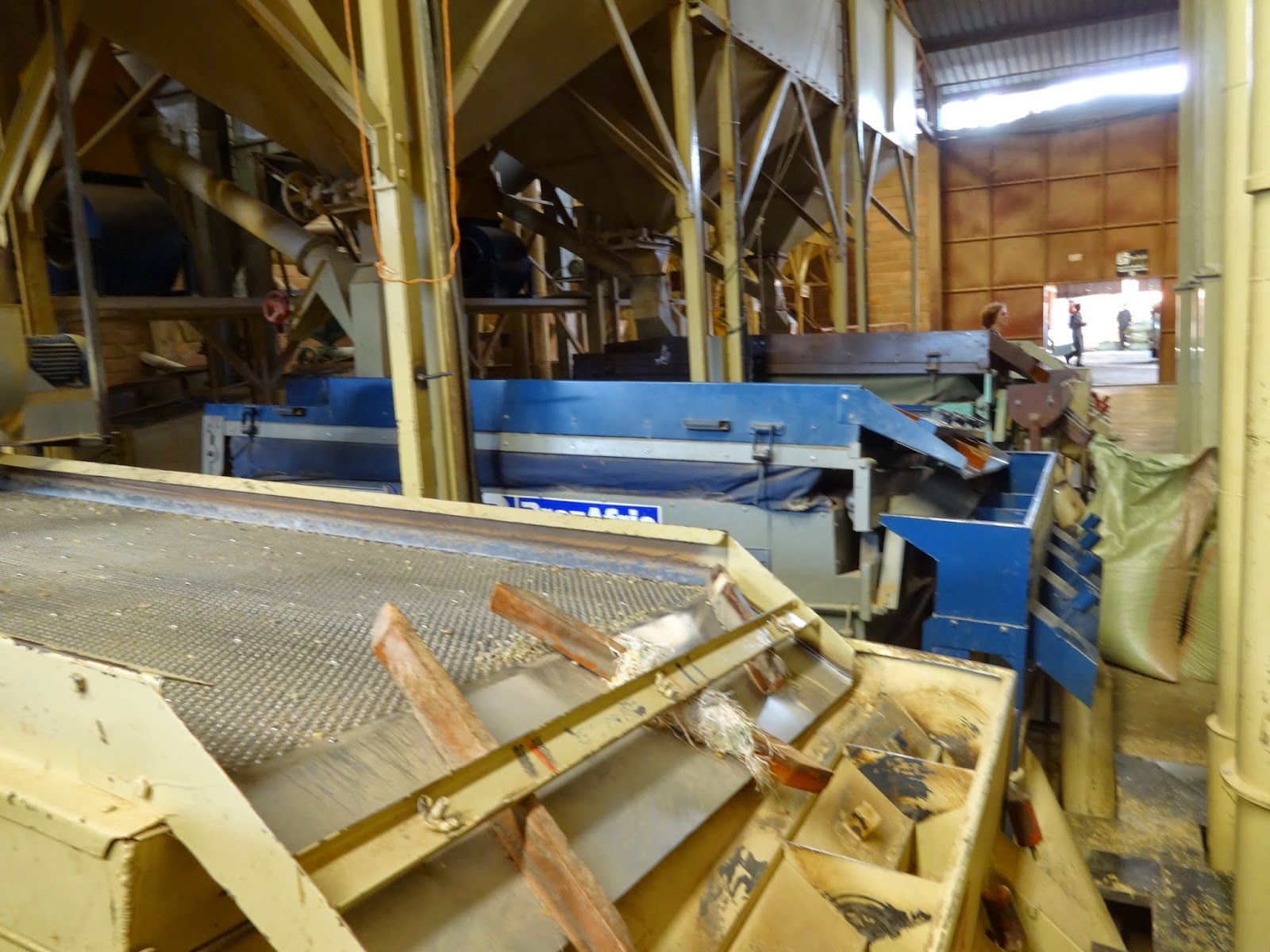
Quality control is an ongoing effort. When they have poor quality cherry at the front end (the raw material)  even their density, size and color sorting machines cannot "clean it up" so they send the coffee to the "hand sorting" room. This is a hall where 600 women (yes 600 and yes all women) sit and pick through coffee all day -- for about a dollar of pay. Raises some questions. Is this the best way to use the firm's resources?*

Lean thinking is all about improving quality and growing organizations. What I have learned is there is no "easy answer" when symptoms such as those above are evident. Careful, participatory waste elimination exercises (involving frontline workers) may prove beneficial. But first, one has to understand management's strategy for the company. Without leadership from the top, lean efforts cannot succeed.


*To learn more about the story of the "coffee sorting ladies" see this article from the New Times of Rwanda, published June 4, 2015:  http://www.newtimes.co.rw/section/article/2015-06-04/189390/

24. Rwanda Field Notes 1

May 18, 2015 - Kigali, Rwanda


Day 1 of our program started with  -- of course -- Starbucks! But this was not your frothy carmel latte Starbucks Cafe. The Starbucks Farmer Support Center is more like a "Hard Rock Cafe" -- it's high quality, it's down-to-earth (literally, since they help farmers with soil analysis among other things) and so much more interesting than a cappucino (in my mind).
First we were introduced to four  of the five full-time staff of the center (1 was missing) and then the agronomist, Aphrodis, gave a great introduction to the history of Farmer Support Centers. He also gave us a lively demonstration of some of the best practice lectures he gives farmers. He emphasized that they are always trying to teach farmers ways to reduce their cost of production and improve quality at the same time. (and no, he was not even talking about lean yet!)


Then we went on to the cupping room where Arsene, Valence and their 4 interns showed us sample roasting and cupping -- including potato taste! Which, thankfully, has been much more rare in this year's coffee. We have seen evidence of improved quality controls to make sure this defect is hard to find in Rwandan coffee.

Thursday, May 14, 2015

23. Costs to Produce Coffee - the danger of averages

May 15, 2015
SCAA Seattle - Apr. 11 - "Cost to Produce vs. Price" Panel

A month ago I had the honor of moderating a panel of three experts at the SCAA conference in Seattle.
The content of this panel was amazing, if I do say so myself as the organizer. The panel members were so awesome in their willingness and ability to deliver real content -- they shared data and details -- a glimpse of the costs they shared are below. But the conclusion from looking at costs was unanimous from all three panelists -- "it's dangerous to use averages." Averages hide variability. If coffee a buyer limits the price paid to a Nicaraguan farmer based on an understanding of a national or even regional "cost to produce" number, that buyer may think he's paying a huge premium, and in fact be part of putting that Nicaraguan farmer out of business.

Ben Carlson, Long Miles Coffee Project and Mark Lundy, CIAT
Mark shared new to the world data on findings from the CRS Borderlands project in Narino, Colombia. His team first segmented coffee producers first by the importance of coffee to their household. He defines the
  1. "Coffee Specialists" (coffee > 50% of income)
  2. "Diversified Coffee Farmers" (coffee income = income from other sources)
  3. "Off-Farm Income Farmers" (coffee < 50% of income).
This is all shown in a beautiful infographic that shares many other details about each of these three segments. Importantly, the costs to produce for each segment are different.
Narino, Colombia Costs:
1. Specialists = $1.58/lb. parchment coffee
2. Diversified = $1.40/lb. parchment coffee
3. Off-farm income = $2.38/lb. parchment coffee

Ben shared data from a 2014 report he helped produce with Integrity Research from London. The work was contracted by the Trademark East Africa group.  Their research included five coffee-growing provinces which would be the majority of the coffee producing provinces. They sliced the data by farm size and showed the following:
Burundi Costs:
< 300 trees = $0.73/lb. parchment
300 - 500 trees = $0.68/lb. parchment
500 - 800 trees = $0.74/lb. parchment
> 800 trees = $0.65/lb. parchment
(using cherry to parchment ratio of 6:1)

Finally, cost data from COSA gave us a remarkable 7 country span:
Country V = $0.52/lb. parchment
Country I = $0.72/lb. parchment
Country N = $0.92/lb. parchment
Country C = $1.12/lb. parchment
Country G = $1.32/lb. parchment
Country K = $1.52/lb. parchment
Country C = $1.96/lb. parchment
(The exact names of countries are intentionally withheld by the author, COSA, in order to avoid over reactions by groups in those countries and also to avoid getting distracted from the point -- which is the wide variety of costs between and within countries.)
Daniele's slide immediately following the numbers above showed profitability for these same countries:

Profitability
Country V = $0.22/lb. parchment
Country I = $0.73/lb. parchment
Country N = $0.78/lb. parchment
Country C = $0.72/lb. parchment
Country G = $0.45/lb. parchment
Country K = $0.17/lb. parchment
Country C = $0.38/lb. parchment

SPECIAL THANKS: to Mark Lundy for impromptu translations as several Spanish-speaking producers came to the microphone.

SPECIAL THANKS to audience members who suffered through my poor translations from French to English of Ben's slides.

SPECIAL THANKS to Daniele Giovannucci because although he couldn't be there due to a time conflict, he arranged to have his organization represented. With several coaching sessions prior to the event, Daniele brought me up to speed so I could present his slides.
b

Tuesday, May 12, 2015

21. Pre-departure for Rwanda -- the current situation

May 12, 2015

The countdown to my departure for Rwanda is at 4 days.  An article just appeared in yesterday's New Times (English newspaper of Rwanda) emphasizing the urgency of the supply chain problem. The headline reads:

"Huye coffee farmers decry low prices, inadequate washing stations"

quote from the article:

The farmers say besides the coffee fetching little [money], the washing stations in the area are overwhelmed by the large quantities of produce that need processing. “Most of the collection centres which used to buy our coffee from the farms have closed because the washing stations where they would take it for processing are overstretched,” said Janvier Mugambira, a coffee farmer from Isimbi Sector.
Washing stations say they are full in Rwanda.

Last year Rwandan farmers were receiving Rfr 220+ for 1 kg cherry. Today the price is at Rfr 170 -- a 23% decline and below the cost of production by most estimates.

This sounds to me like a situation where the value stream mapping I practiced at Definity University last month may help. If we can visualize where the waste is and quantify how big it is, then usually decision-makers get interested in spending some time to reduce it. I look forward to having that data and then doing some cause and effect analysis with key stakeholders. Where do they feel the main bottlenecks are?  Where should action should be prioritized? Would it make a difference if productivity at washing stations could be improved 10, 20 even 30%?
Stay tuned...